
If you’re looking for the software house to implement a custom advanced technology for your business, you’re in the right place.
We love the challenges of advanced IT projects and crafting robust systems. Customised open source components let us deliver what you need in the best time and budget possible.

Digital decisioning
We build custom systems on top of digital decisioning tool Nussknacker. Implementations include real-time marketing, fraud detection, revenue assurance systems.

Systems integration
TouK implements and upgrades system integration software of all levels of complexity. We take great care to ensure they guarantee both well-cooperating services and data integrity.

Databases
We have the necessary skills to tackle petabytes of data, enabling you to turn data into business insights. Whether you need a traditional relational database or want to use non-normalized data in a NoSQL repository, we’re here to help.

Enterprise applications
From SMBs to corporations, custom enterprise applications require a skilled software project team. We’ve got what you need – developers and UX designers with years of experience in developing applications that are both efficient and user-friendly.

IT reorganisation
Do you want to replace legacy software but business continuity disruptions restrain you from the big decision? We are experienced in agile re-engineering of key company systems, maintaining full continuity of business processes within your organization.

Project rescue squad
Faulty legacy systems, unhelpful software providers, fluctuating business concepts, changing legal regulations – crisis can happen when you least expect it. TouK teams are agile and provide technological versatility you will need when dealing with critical situations.
Planning your project

Would you like to solve a business problem with a custom software solution? Or maybe you have a product idea in mind? Let’s take a closer look!

Together, we will walk through your assumptions and present our solution as an outcome of the process. If needed, we will build a prototype to ensure that the final result will meet the expectations.

It’s time to draw up an initial plan. Taking into account your time constraints, budget and technology preferences, we’ll find out the best possible option.

When we’re on the same page and ready to start, it’s time to select a dedicated full-time team to deliver your project.
Software development
Business requirements change faster than most ISVs can withstand. We create software that anticipates future changes and provides ultra-lasting quality. Our teams use XP practices and organize their work using Scrum and Kanban methods.
We are software experts, not just programmers. We provide a diverse skill set needed to succeed as an ISV. This includes writing software specifications, code, automated tests, and documentation. We’re also capable of solving tough algorithmic problems.

Plan

Development
and testing

working
software

feedback and
adaptation
We are Java, Scala and Kotlin fans but with each new project, we choose the most applicable technologies and leverage their strengths. We can do this because we know the tool stack inside out – our developers are recognised for their expertise in the IT community.
We have cooperated with most of our clients for years. They are several large and medium enterprises from different businesses whose trust we have won through our expertise, hard work and initiative that creates value. We ensure that our clients enjoy top quality in their IT systems with low maintenance costs.
Since 2002 we have worked for: telecommunications, media & digital communications, financial services, banking, utility, logistics, publishing and security sector companies.
Our clientele is spread around the globe, featuring companies from Poland, United Kingdom, Romania, Denmark, Ireland, United States and Nigeria.
Workshops
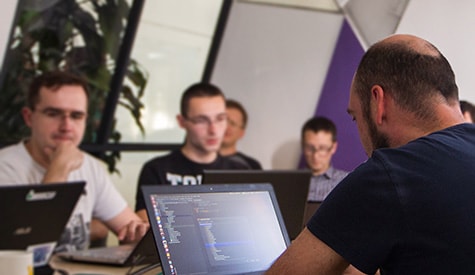
We promote self-development and knowledge sharing by organizing internal workshops. Instead of hiring external trainers, we encourage our employees to teach one another, with high standards and a broad scope of topics – from new technologies and improving code quality to public speaking and presenting. On top of that, we stimulate our creativity and problem-solving skills during internal hackatons.
Culture
TouK is a place for hungry minds who are excited about learning new things. We are not afraid to walk an extra mile in our development as technology masters and team players. While we set the bar high, we also help everyone reach it by mutual education and cooperation. We are also proud to have a bunch of recognised industry experts and speakers on board.
Knowledge sharing
At TouK, we learn how to speak in public and give presentations. We share our knowledge at many conferences in Poland and abroad, where we share what we've learned during our work.

Nurturing the developer community
We frequently take part in conferences as attendees, sponsors, and co-organizers. Additionally, we are eager contributors to many open source projects.